Quick guide: 5 best HubSpot CPQ solutions for manufacturing teams
- Quotivity CPQ: The top HubSpot-native CPQ for manufacturers needing complex pricing, guided selling, and margin protection
- DealHub: Quote-to-revenue platform with deal room capabilities for mid-market teams
- PandaDoc: Document-focused CPQ with proposal automation for sales teams
- Mobileforce: No-code CPQ with offline functionality for field sales
- QuoteWerks: Established quoting software with multi-source product databases
- HubSpot Native Quoting: Built-in quoting for straightforward deals
How we chose the best HubSpot CPQ software for manufacturing
Selecting the right CPQ for your manufacturing operation means looking beyond basic quoting features. You need a tool that handles the unique complexities of physical product configuration, tiered pricing structures, and approval workflows that protect your margins.
Here's what we evaluated when building this list:
- HubSpot integration depth: Does the CPQ sync bi-directionally with your deals, contacts, and product library without requiring middleware?
- Complex pricing support: Can it handle volume discounts, calculated pricing, usage-based models, and subscription billing that manufacturers often need?
- Configuration capabilities: Does it support product bundles, required accessories, and dependency rules that prevent invalid configurations?
- Approval workflows: Can you set discount thresholds, margin floors, and multi-level approvals to protect revenue?
- Implementation timeline: How quickly can your RevOps team get the system running without heavy developer involvement?
- Guided selling features: Does the tool help reps build accurate quotes through intelligent prompts rather than memorizing every product rule?
The 6 best HubSpot CPQ solutions for manufacturing and complex quoting
1. Quotivity CPQ: Best overall HubSpot CPQ for manufacturers
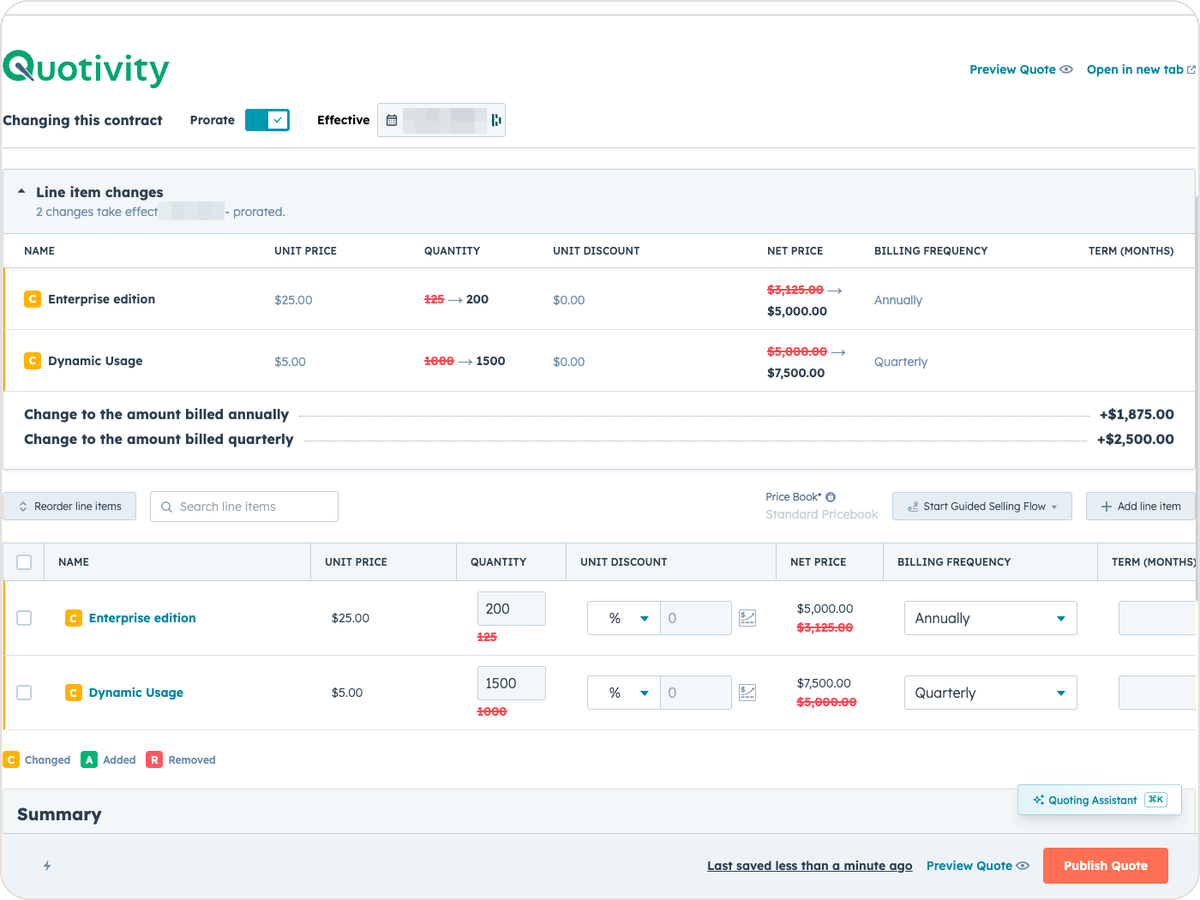
Quotivity (yes, that's us) delivers the most complete HubSpot-native CPQ experience for manufacturers dealing with complex product configurations and pricing logic. Everything happens inside your existing HubSpot workspace—deal records, products, approvals, and reporting all live where your reps already work.
What sets Quotivity apart is how it handles the real-world complexity manufacturers face. Your price books can include floors, targets, and scheduled pricing changes. Bundles mirror actual product relationships with required accessories and service lines built in. The guided selling module walks reps through question-based configuration so they quote accurately without memorizing every product dependency.
For RevOps teams, Quotivity offers point-and-click rule building with versioned price books. You can ship your first quoting path in days and expand confidently knowing the system blocks bad quotes before they reach customers. Finance teams appreciate the audit trails and approval queues that log every action and notification.
Quotivity features
- Dynamic price books: Centralize your product and pricing data with scheduled price changes that take effect automatically
- Guided selling module (coming soon): Simplify complex product configuration through question-based SKU generation that prevents invalid combinations
- Multi-level approvals: Set discount thresholds and margin checks with automatic routing to the right approvers based on deal attributes
- Configurable products (aka bundles): Build Good-Better-Best packages with required items, tiered bundling, and built-in math for faster upsells
- Quote document automation: Attach supporting documents directly into quote PDFs and collect payments from quotes
- Usage and calculated pricing: Handle volume-based pricing, formulas, and hybrid models that manufacturing frequently requires
Quotivity pros and cons
Pros:
- Truly native to HubSpot with no parallel system to maintain or learn
- Guardrails automatically block quotes that violate pricing rules or margin requirements
- Fast implementation with point-and-click configuration that RevOps owns directly
Cons:
- Teams new to CPQ may need time to fully map their existing pricing logic into the system
- Advanced template customization requires some familiarity with the template builder
2. DealHub: Quote-to-revenue platform with deal rooms
DealHub offers a combined CPQ, CLM, and billing solution that has a connection to HubSpot CRM. The platform focuses on guided selling playbooks that walk reps through quoting workflows and approval processes. DealHub's deal room feature creates a central location where buyers can review proposals and complete the purchase process.
The platform connects standard HubSpot objects with its quoting system, syncing deal data according to configurations you define. Implementation typically takes 2-3 months depending on your configuration complexity. No coding is required for basic setup, though teams with elaborate pricing structures should plan for additional configuration time.
DealHub features
- Guided playbooks: Interactive workflows that direct reps through quoting steps
- DealRoom: Buyer-facing portal for reviewing and completing deals
- Subscription billing: Manage recurring revenue models within the platform
DealHub pros and cons
Pros:
- Combines CPQ, CLM, and billing in one platform
- Deal rooms create a professional buying experience
- No-code configuration for simple setups
Cons:
- Implementation timeline runs longer than some alternatives
- Advanced configurations may require dedicated RevOps resources
- Feature depth can exceed what simpler sales processes need
3. Mobileforce: CPQ with offline functionality
Mobileforce offers a CPQ platform that emphasizes quick setup and offline capabilities. The platform includes a rules engine for pricing logic, multi-party approval workflows, and integration with ERP and inventory systems. A distinguishing feature is the ability to generate quotes and update the CRM even without internet connectivity.
The platform connects to HubSpot and supports multiple pricing methodologies including fixed, variable, tiered, and subscription-based models. Mobileforce also offers field revenue operations features for teams with outside sales reps who need mobile quoting capabilities.
Mobileforce features
- Offline quoting: Create and modify quotes without internet access
- No-code rules engine: Configure pricing and approval logic without developers
- ERP integration: Connect to back-end systems for inventory and pricing data
Mobileforce pros and cons
Pros:
- Offline functionality serves field sales teams well
- No-code configuration reduces IT dependency
- Supports multiple pricing methodologies
Cons:
- Limited product configuration capabilities
- Smaller user community compared to more established platforms
- Some advanced features may require additional modules
- Documentation and training resources are still developing
5. QuoteWerks: Established quoting software with multi-source products
QuoteWerks has operated for over 25 years as a dedicated quoting and proposal solution. The platform integrates with HubSpot to pull contact and deal data, then pushes quote information back to keep pipeline values accurate. QuoteWerks supports accessing products from multiple sources including HubSpot, distributors, and external databases.
The platform includes tools like Paste Special that let reps quickly duplicate and modify quote sections. QuoteWerks handles recurring revenue, bundles, and configurations with templates that standardize the quoting process across teams. Quote PDFs attach automatically to HubSpot deals for visibility.
QuoteWerks features
- Multi-source products: Pull pricing from HubSpot, distributors, and other databases
- Paste Special tools: Quickly replicate and adjust quote sections
- Automatic deal sync: Line items and totals update HubSpot deals in real time
QuoteWerks pros and cons
Pros:
- Long track record with established feature set
- Multi-source product access is useful for resellers
- Detailed control over quote construction
Cons:
- Interface feels more "old school" compared to newer platforms
- Not a native HubSpot app—operates as a connected external system
- Learning curve for teams new to dedicated CPQ software
5. HubSpot Native Quoting: Built-in quoting for straightforward deals
HubSpot includes built-in quoting tools that work directly within the CRM. For teams with straightforward pricing and simple product catalogs, native quoting handles basic quote generation without additional software. Quotes connect to deals automatically and support e-signatures and payment collection.
The native solution works well as a starting point. As quoting complexity grows—more products, bundled offerings, pricing rules that vary by customer or volume—teams typically find they need more structure than native quoting provides.
HubSpot Native features
- Built-in product library: Create and manage products within HubSpot
- E-signature support: Collect signatures without additional tools
- Payment collection: Accept payments directly through quotes
HubSpot Native pros and cons
Pros:
- No additional software to purchase or integrate
- Works natively within existing HubSpot workflow
- Simple setup for basic quoting needs
Cons:
- Limited support for complex pricing models and configurations
- No advanced approval workflows or margin controls
- Bundle and configuration capabilities are basic
Comparison table: The best HubSpot CPQ software for manufacturing
| Platform | Native HubSpot Integration | Guided Selling | Multi-Level Approvals | Dynamic Price Books |
|---|---|---|---|---|
| Quotivity | ✓ | ✓ | ✓ | ✓ |
| DealHub | Connector | ✓ | ✓ | ✗ |
| Mobileforce | Connector | ✗ | ✓ | ✗ |
| QuoteWerks | Connector | ✗ | ✗ | ✗ |
| HubSpot Native | ✓ | ✗ | ✓ | ✗ |
What should manufacturers look for in a HubSpot CPQ?
Manufacturing companies face quoting challenges that generic CPQ tools often miss. Your products have dependencies—certain components require specific accessories, service packages need to align with hardware purchases, and pricing varies based on volume, customer tier, or contract terms.
Start by evaluating how each CPQ handles product configuration rules. You need a system that prevents reps from quoting combinations that can't be built or delivered. The right tool guides reps through valid options rather than relying on their memory of every product relationship.
Consider how pricing logic works in each platform. Manufacturing often involves calculated pricing based on dimensions, materials, or labor hours. Volume discounts layer on top of base prices. Multi-currency support matters if you sell internationally. Your CPQ should handle these scenarios without requiring spreadsheets alongside the quoting tool.
How do approval workflows protect manufacturing margins?
Approval workflows do more than add a signature step to your quotes. They create systematic protection against margin erosion that happens when reps discount beyond acceptable levels or miss required items in configurations.
Effective CPQ approval systems let you set discount thresholds that trigger automatic routing to managers or deal desk. You can establish margin floors that block quotes from proceeding until someone with authority approves the exception. These controls mean finance teams can relax knowing the system catches problems before they become customer commitments.
Audit trails matter as much as the approvals themselves. When you can see who approved what, when, and why, you have the documentation needed for compliance reviews and the data to optimize your pricing strategy over time.
Why Quotivity is the best HubSpot CPQ for manufacturers
Manufacturing teams need more than basic quote generation. You need a system that understands product complexity, enforces pricing governance, and keeps your reps working in HubSpot rather than switching between tools.
Quotivity delivers on all three requirements. The platform lives entirely within HubSpot, so there's no parallel system for reps to learn or data to reconcile. Price books with automatic scheduling, configurable bundles with required items, and multi-level approvals with full audit trails give you the control manufacturing demands.
The guided selling module is where Quotivity really shines for complex quoting. Instead of expecting reps to memorize every product dependency and pricing rule, the system walks them through configuration with intelligent prompts. The result is accurate quotes that protect margins while moving deals forward quickly. Request a demo to see how Quotivity handles your specific manufacturing quoting challenges.
FAQs about CPQ software for manufacturers using HubSpot
What is CPQ software and why do manufacturers need it?
CPQ stands for Configure, Price, Quote. It's software that helps your sales team build accurate quotes by guiding them through product selection, applying the right pricing rules, and generating professional proposals.
Manufacturers need CPQ because your products have complexity that spreadsheets can't reliably handle. When you're dealing with configurable products, volume pricing, and approval requirements, Quotivity keeps everything organized in one system.
Can HubSpot's built-in quoting handle manufacturing complexity?
HubSpot's native quoting works well for straightforward deals with simple pricing. Once you need configurable bundles, tiered pricing, approval workflows, or margin protection, you'll typically outgrow what native quoting offers.
That's when manufacturers move to a dedicated CPQ like Quotivity that handles complex scenarios while keeping everything inside HubSpot.
How long does it take to implement a CPQ solution?
Implementation timelines vary significantly by platform. Enterprise CPQ solutions often take 6-12 months with extensive IT involvement. Quotivity focuses on fast implementation—you can ship your first quoting path in days using point-and-click configuration that RevOps manages directly.
The key difference is whether you need developers to build custom code or can configure rules yourself.
What's the difference between native and connector-based CPQ solution?
Native CPQ apps like Quotivity run entirely within HubSpot. Your reps never leave the interface they already know. Connector-based solutions operate as separate applications that sync data with HubSpot through an integration layer.
Native solutions typically offer faster adoption since there's no new system to learn. They also avoid the sync delays and data conflicts that can occur with external connectors.
How does CPQ software protect profit margins?
CPQ protects margins through automated guardrails. You set price floors, discount thresholds, and required approval levels based on deal characteristics. When a rep tries to quote below acceptable margins, the system either blocks the quote or routes it to the right approver.
Quotivity makes this particularly straightforward with price books that include built-in floors, targets, and margin checks. Reps move faster because the system guides them, and finance relaxes because bad quotes get blocked automatically.