Product Releases: September Wrap Up
 Ryan Huff: Oct 2, 2026, 12:00:00 AM
Here's what shipped and which plans each one is on. Ramp Pricing and Deal fields are the only Enterprise plan item, and the rest reach every plan.
When Renée Durrance stepped into her hybrid business systems and RevOps role at Aptarro, a healthcare SaaS company, quoting wasn’t just inefficient—it was nearly nonexistent as a structured process.
Sales reps built deals manually inside HubSpot, adding line items one by one and referencing pricing from spreadsheets saved locally on their desktops. Each rep relied on their own version of the “truth.”
“There was an Excel pricing table somewhere that they saved to their desktop,” Renée explained. “It was very freeform.”
This created a system where pricing varied wildly from deal to deal. There were no guardrails, no approval workflows, and no reliable connection between what was quoted, what was contracted, and what was ultimately billed.
As the company grew, the cracks widened.
"What initially felt like flexibility was actually a lack of governance—sales reps could adjust pricing and terms freely, without formal constraints or approvals.”
“One partner’s customer might have a completely different price than another partner’s customer,” Renée said. “That leads to distrust—and it snowballs quickly.”
Leadership knew the problem had escalated beyond operational inefficiency—it was now a business risk.
Pricing variability had become unsustainable, prompting Aptarro to undertake a comprehensive rewrite of its price book to restore consistency.
At the same time, the company attempted to formalize an approval process across departments—but quickly hit a wall.
“We drafted an approval procedure and had legal, finance, and sales all sign off,” Renée said. “Then we realized HubSpot couldn’t accommodate what we needed.”
The combination of complex pricing dependent on product variants and multi-layered approvals simply couldn’t be supported.
That was the moment they decided: something had to change.
.png?width=672&height=378&name=Case%20Study%20-%20Aptarro%20-%20quote%20(1).png)
The team evaluated multiple options including extending their existing tools and exploring other CPQ solutions.
Quotivity stood out immediately.
Key decision drivers included:
“Product variants was huge for us—it was one of the first things we used to weed out candidates,” Renée said. “And nobody could do HubSpot-native like Quotivity.”
The team quickly realized that before they could implement a CPQ system, they needed to fix their underlying pricing structure.
“We knew we had gaps,” Renée said. “But the more we dug in, the more we realized how many different ways we were pricing just a few products.”
Over several months, the team rebuilt their pricing from the ground up. They aligned on profitability, market positioning, and standardization. Quotivity worked alongside them throughout, providing hands-on support and implementation as they developed and refined complex pricing models.
At the same time, they made a strategic decision to implement CPQ and CLM together.
“We didn’t want one system to fail because the other wasn’t ready,” Renée explained. “So we launched both at the same time and trained users end-to-end.”
With Quotivity in place, quoting shifted from manual guesswork to a structured, automated system.
| Before | After |
| Reps manually entered line items in HubSpot | Quotes are generated automatically based on structured inputs |
| Pricing pulled from inconsistent spreadsheets | Pricing logic is embedded in the system |
| Volume pricing tracked only in contracts | Approval workflows enforce guardrails |
| Contracts required manual construction of pricing tables | Contracts pull directly from CRM data—no manual entry required |
“They don’t have to touch the contracts anymore,” Renée said. “It’s all pulling from the CRM, and it eliminates that whole process.”
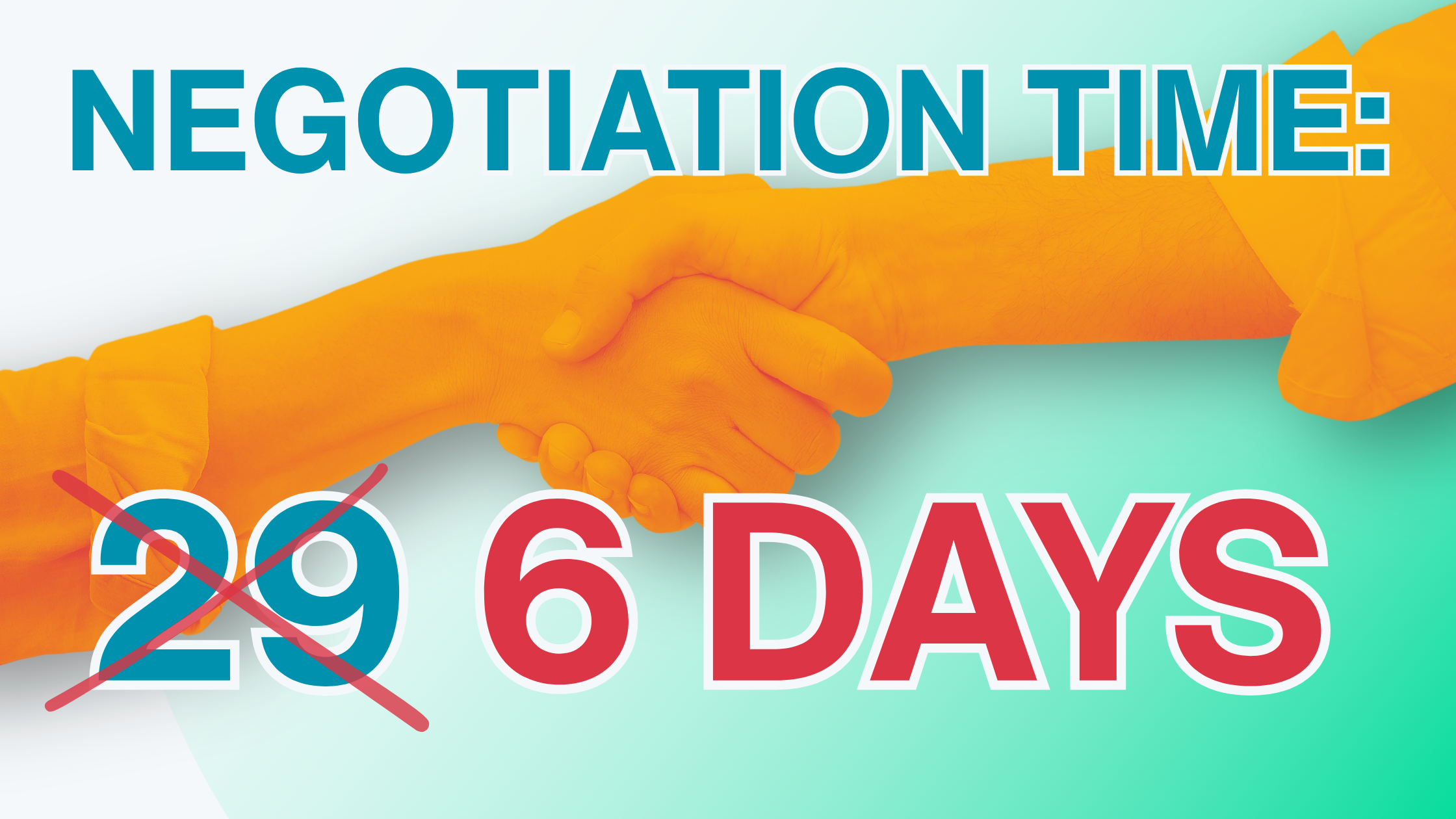
After implementing Quotivity, the company dramatically reduced time spent in the negotiation stage, going from about 29 days in negotiation on average to 6.
This acceleration reflects faster quoting but also fewer errors, less back-and-forth, and smoother contract alignment.
Sales reps now follow standardized pricing because deviations require approvals—which slows deals down.
“The reps are incentivized to stick to the price book because they can get their deal out the door much faster.”
With structured pricing and approval gates in place, unnecessary discounting has decreased.
The alignment between quote, contract, and billing has eliminated many downstream issues.
No more reconciling mismatched data across systems.
Deal review calls have dramatically improved.
“Our deal review calls are shorter—or canceled altogether—because there are no deals to review.”
Executives now trust that pricing is consistent and controlled.
“There are now locks and constraints. Leadership isn’t chasing deals around anymore.”
Sales, finance, legal, and operations are now working from the same data and logic.
Customers receive consistent, transparent pricing.
Contracting friction has decreased, and pricing conversations are clearer.
“Contracting used to be a significant drain on time,” Renée said. “That’s improved considerably across the board.”
By replacing manual, inconsistent quoting processes with a structured CPQ system, this healthcare SaaS company transformed how it sells, prices, and delivers its products.
The result: faster deals, better control, and a foundation for scalable growth.
👉 Get a demo and see how Quotivity can help you standardize pricing, accelerate deals, and align your entire revenue operation.

Ryan Huff: Oct 2, 2026, 12:00:00 AM
Here's what shipped and which plans each one is on. Ramp Pricing and Deal fields are the only Enterprise plan item, and the rest reach every plan.
 Ryan Huff: Sep 30, 2026, 9:50:30 AM
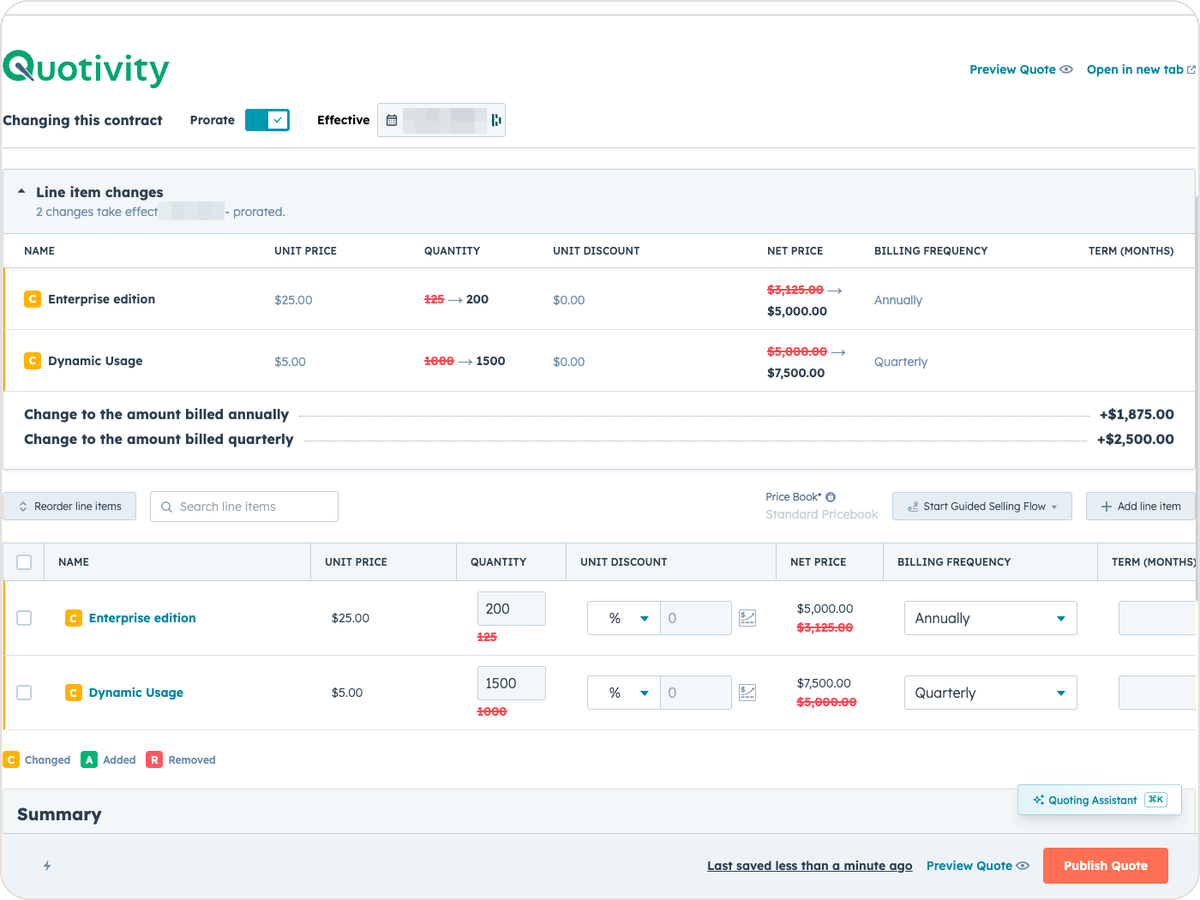
An equipment maker sells a bottler one packaging line. Partway through the term, the bottler calls back. Two more lines are going in, and they want...
Ryan Huff: Sep 2, 2026, 12:00:00 AM
Three changes from August for whoever maintains your Quotivity setup. Two of them, BLANKVALUE and bundle member summaries, are on the Enterprise plan.

 Quotivity : Apr 7, 2026, 8:06:23 AM
From margin creep and manual quoting to faster deals, tighter pricing control, and better customer alignment.
Ryan Huff : Sep 30, 2026, 9:50:30 AM
Quotivity quotes now create and update HubSpot contracts. Follow one through a mid-term change quote and a renewal.
 Quotivity : Apr 21, 2026, 2:00:35 PM
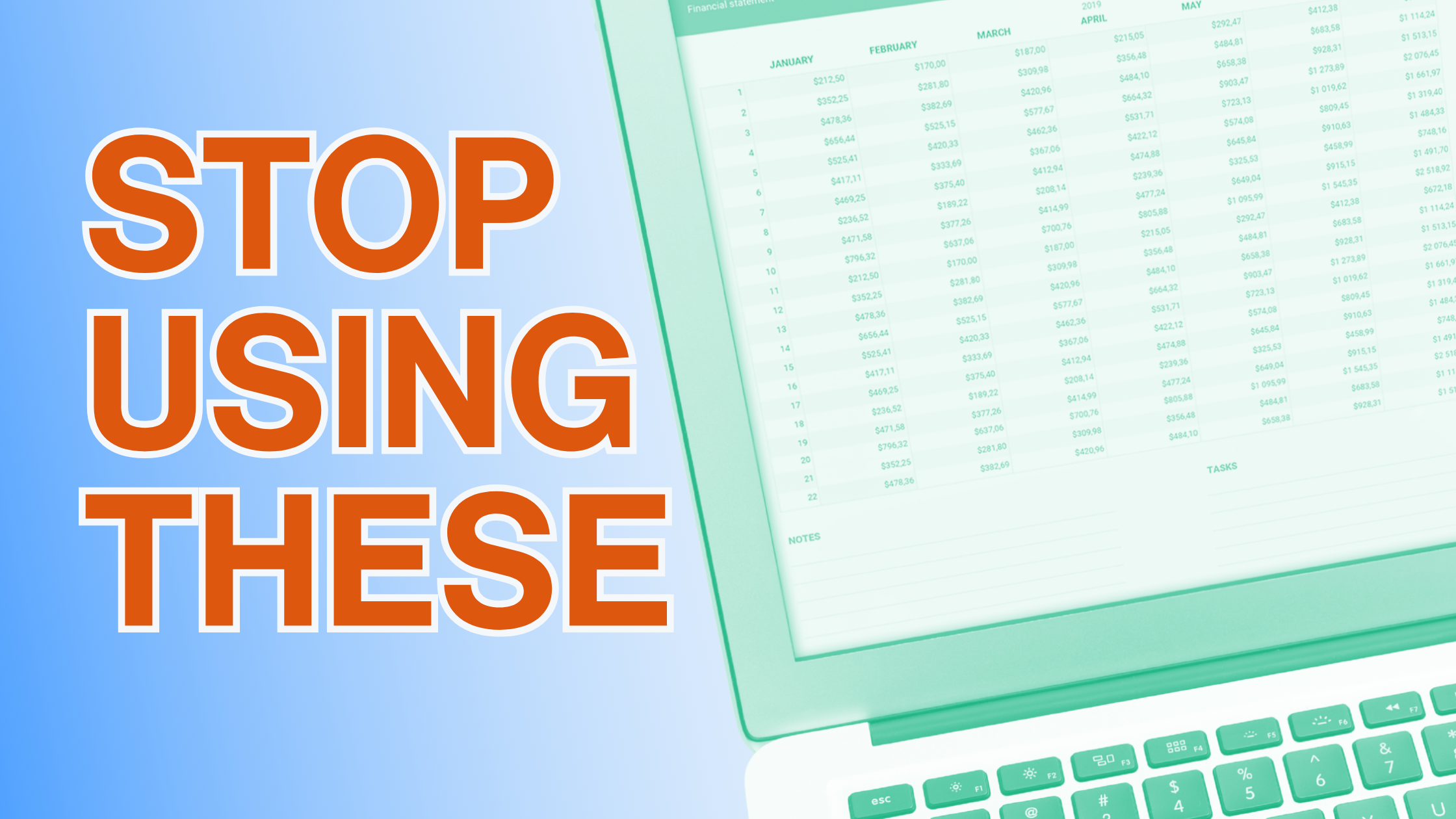
Spreadsheet-based quoting is a major problem. Quotivity, a HubSpot-native CPQ, can streamline your quoting process, reduce errors, and enhance...