Product Releases: September Wrap Up
 Ryan Huff: Oct 2, 2026, 12:00:00 AM
Here's what shipped and which plans each one is on. Ramp Pricing and Deal fields are the only Enterprise plan item, and the rest reach every plan.

Here's the workflow most manufacturers live with: A rep builds a quote in HubSpot. The customer signs. Then somebody has to get that order into NetSuite, or Epicor, or Prophet 21, or QuickBooks, with the right item numbers, the right contract price, the right freight, and the right ship-from.
Somewhere in there, the numbers stop matching.
HubSpot is where the deal lives. The ERP is where the order, the inventory, and the money live. Both systems are doing exactly the job they were built for. The quoting problem lives in the gap between them, and the rep is the one doing the math in the middle. Or, as one CRO put it on a recent call: reps spend half the day feeding the ERP and the other half actually talking to the customer.
So why is HubSpot ERP quoting integration harder than the integration vendor's slide deck made it look? Here's what the customers who've closed the gap actually did.
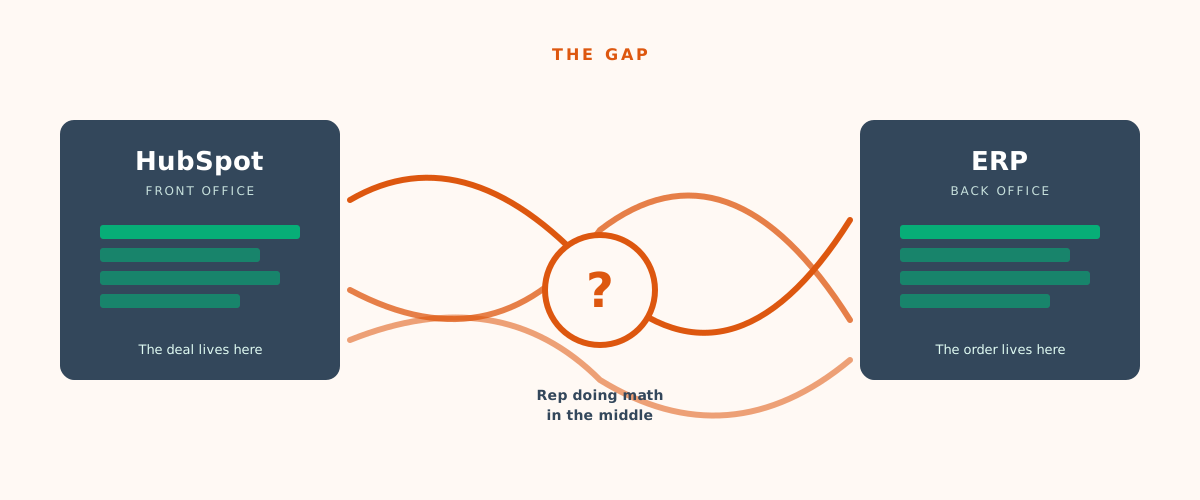
HubSpot was built around the deal. ERPs were built around the order. Neither one was meant to do the other's job, and neither one is wrong for being good at the job it does.
Most teams treat this as a sync problem. The sync is the easy part. The harder part is that two systems are telling slightly different stories about the same customer, and the rep is the one having to reconcile them every time they build a quote. That reconciliation usually happens in somebody's head, in a spreadsheet, or in a phone call to the one person in the building who knows which item number goes where.
A rep quotes a part by the name they remember. The ERP has it under a different number, or it's been retired, or somebody renamed it for a customer eight months ago. The quote goes out clean. The order can't get cut without somebody fixing it by hand.
That looks like a data problem. The actual answer is workflow: the rep needs to see the right item number at the moment they're building the quote, not the day after.
Contract prices, distributor tiers, GPO eligibility, territory adjustments, volume breaks. All of that sits in the ERP. In HubSpot, the rep is quoting off the list price, off memory, or off gut.
The result is what one sales director described on a recent call: there's no real list price, and every rep picks the margin they feel like making. Your margins end up exposed to the entire sales team, every time they build a quote.
The ERP calculates freight, surcharges, and taxes from rules. The HubSpot quote builder asks the rep to remember them. Quotes go out under or over. Finance finds out at the invoice, which is roughly the worst possible moment.
This one is also the hardest to see from the outside. The quotes look fine. The deals close. The leakage shows up later, line by line, in the gap between what was quoted and what was invoiced.
Somebody re-keys it. Sometimes that somebody is the operations manager. Sometimes it's a long-tenured admin. Sometimes, as one customer described it, one person in the building knows how every order really gets cut, and when they're out, things stop.
Either way, you've got a single point of failure with a vacation policy.
Inventory and lead times live in the ERP. The rep building the quote can't see either. So promises get made on parts that are backordered, or on items the shop floor already knows are weeks out, and the customer finds out after they sign. That's the moment your delivery promise becomes a problem for someone in customer service.
Teams hear all of the above and reach for a sync. Push the products from the ERP into HubSpot once a night and call it done.
That handles the list. It doesn't handle the rules. The rules are the part that costs money. This customer gets a 12 percent contract discount. This territory adds a freight surcharge. This product has a floor price below which the quote needs approval. This item is on backorder until June. A sync that runs at 2 a.m. doesn't help the rep at 10 a.m. building a quote in HubSpot. The quote still gets built on guesswork. The handoff to the ERP still gets re-keyed by hand.
The honest version of HubSpot ERP quoting integration is that the catalog sync is the easy 30 percent. The rules and the round-trip are the hard 70.
These come from the customers who've closed the gap. Same number as the breaks, mirrored on purpose.
Items, prices, and inventory come from the ERP into HubSpot. Quotes and deal activity stay in HubSpot. No two-way arguments about who owns what.
Contract prices, customer-specific discounts, GPO eligibility, territory adjustments. The right price shows up the moment the rep adds the line item, not the next morning.
The rep doesn't have to memorize it. The PO writes itself when the quote is accepted. The "one person who knows" stops being a dependency, and the order doesn't sit in their inbox while they're on vacation.
Pulled from the same tables the ERP uses. No mental math on the quote. The number on the proposal is the number on the invoice.
No re-keying. The ERP gets a clean order with the same numbers the customer signed for. Sales gets their close. Operations gets a clean PO. Finance gets a quote that ties to the invoice.
First, map your current handoff. Walk one quote from the deal record to the PO and write down every place a human types something. That list is your punchlist.
Second, find the pricing rules that only one person knows. Get them out of their head and onto paper. The rules that live in someone's memory are the rules that leak revenue.
Third, decide which system owns which fact. HubSpot owns the deal. The ERP owns the order, the inventory, and the price. Write that down. Then enforce it.
Fourth, put a CPQ layer between HubSpot and the ERP that runs the rules at the moment the rep is quoting, not the next morning. That's the part most integrations miss, and it's the part that determines whether HubSpot ERP quoting integration actually pays back.
Manufacturers on NetSuite, Epicor Prophet 21, and QuickBooks are running HubSpot ERP quoting integration cleanly today. What they have in common is a quoting layer in HubSpot that runs the rules at the moment the rep is building the quote, against ERP data that's already where it needs to be.
That's the work Quotivity does. If you're stuck somewhere between the catalog sync and the rules, that's a good conversation to have.

Ryan Huff: Oct 2, 2026, 12:00:00 AM
Here's what shipped and which plans each one is on. Ramp Pricing and Deal fields are the only Enterprise plan item, and the rest reach every plan.
 Ryan Huff: Sep 30, 2026, 9:50:30 AM
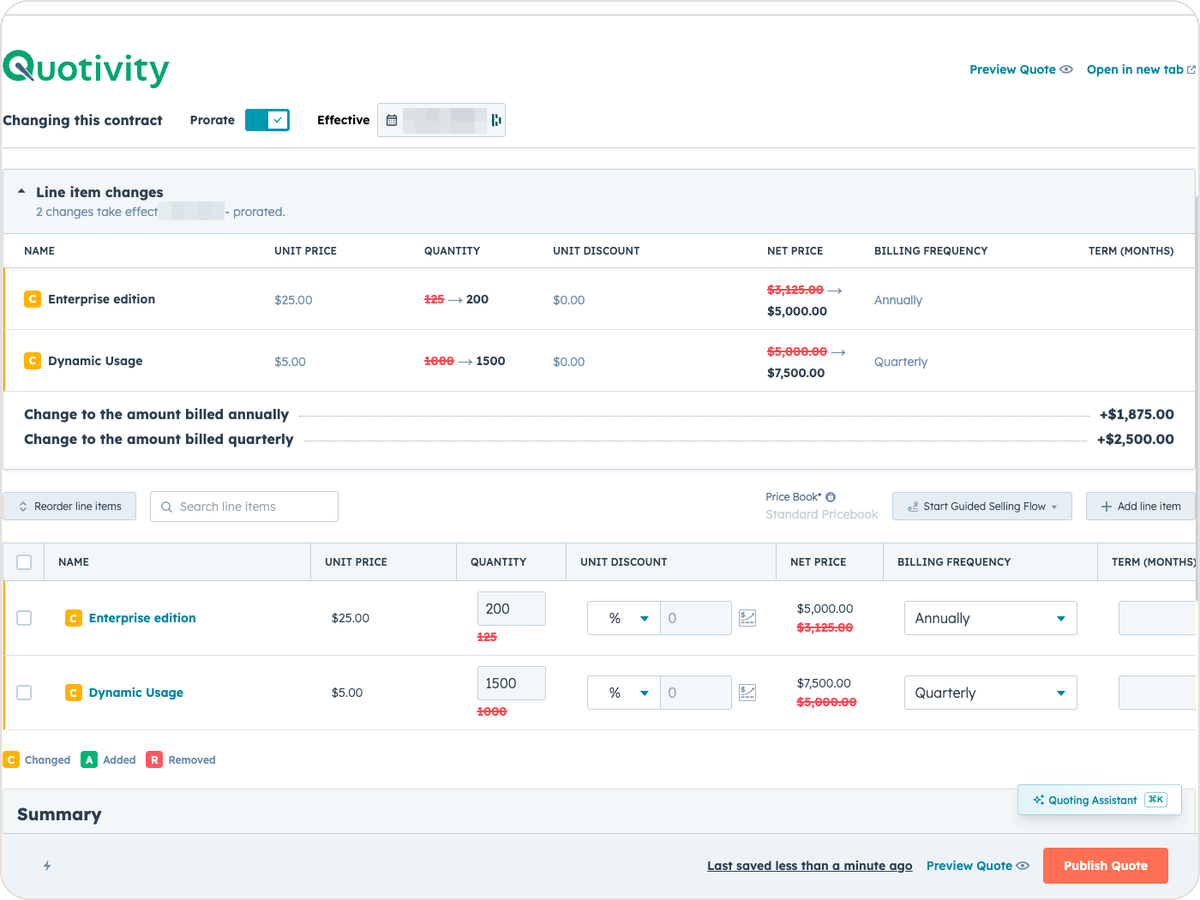
An equipment maker sells a bottler one packaging line. Partway through the term, the bottler calls back. Two more lines are going in, and they want...
Ryan Huff: Sep 2, 2026, 12:00:00 AM
Three changes from August for whoever maintains your Quotivity setup. Two of them, BLANKVALUE and bundle member summaries, are on the Enterprise plan.
 Quotivity : Mar 17, 2026, 7:45:00 AM
If quotes take too long to build, pricing lives in spreadsheets, or discount approvals slow deals, your team may have outgrown its quoting process....
 Quotivity : Aug 17, 2026, 9:43:48 AM
Discover how clients express their quoting challenges without using the term CPQ and learn how to identify their needs through effective questions.
 Quotivity : Apr 28, 2026, 5:15:00 AM
Quote approvals are languishing in your emails and killing your deals. Integrate them into your workflow to eliminate delays, enhance visibility, and...