
Skip to content
Back to Blog How to Build a Quote Approval Workflow That Doesn't Kill Your Deal Velocity
approvals

How to Build a Quote Approval Workflow That Doesn't Kill Your Deal Velocity

A quote approval workflow kills deals when it's built to protect the company instead of close it. Here is how to design one that does both.

Quotivity
Quotivity

Jul 28, 2026

A rep closes out Monday with a quote that's 97% done. The customer is ready to move. The only thing holding it up is a manager signature on a 5% discount. The manager is traveling. The rep follows up Tuesday morning. Gets a response Tuesday afternoon. The customer has already started a conversation with a competitor. The deal closes eventually, but it cost three days and almost cost the account.

This is the approval workflow working exactly as designed. The protection was there. The oversight was there. The problem is that it applied to every quote equally, including the ones that didn't need it.

Why most quote approval processes slow deals down

The most common setup is the simplest one: every quote above a certain dollar threshold, or every quote at all, requires manager sign-off before it goes to the customer. It's easy to administer. It gives finance and leadership visibility. And it guarantees that a rep quoting a standard job at full list price waits in the same queue as a rep offering a 22% discount on a margin-sensitive account.

When approval is mandatory for every deal, the bottleneck is permanent. It doesn't scale with volume, and it doesn't distinguish between a routine renewal and an exception that actually needs a second set of eyes.

The result is what most sales teams already know: reps find workarounds. They quote closer to the line to avoid triggering approval. They call the manager directly and get a verbal yes before the formal request processes. Or they send the quote and route the approval after the fact. The workflow exists on paper, but the deals are moving around it.

How to build a quote approval workflow: three design decisions

Three decisions separate approval workflows that protect margin from ones that create drag.

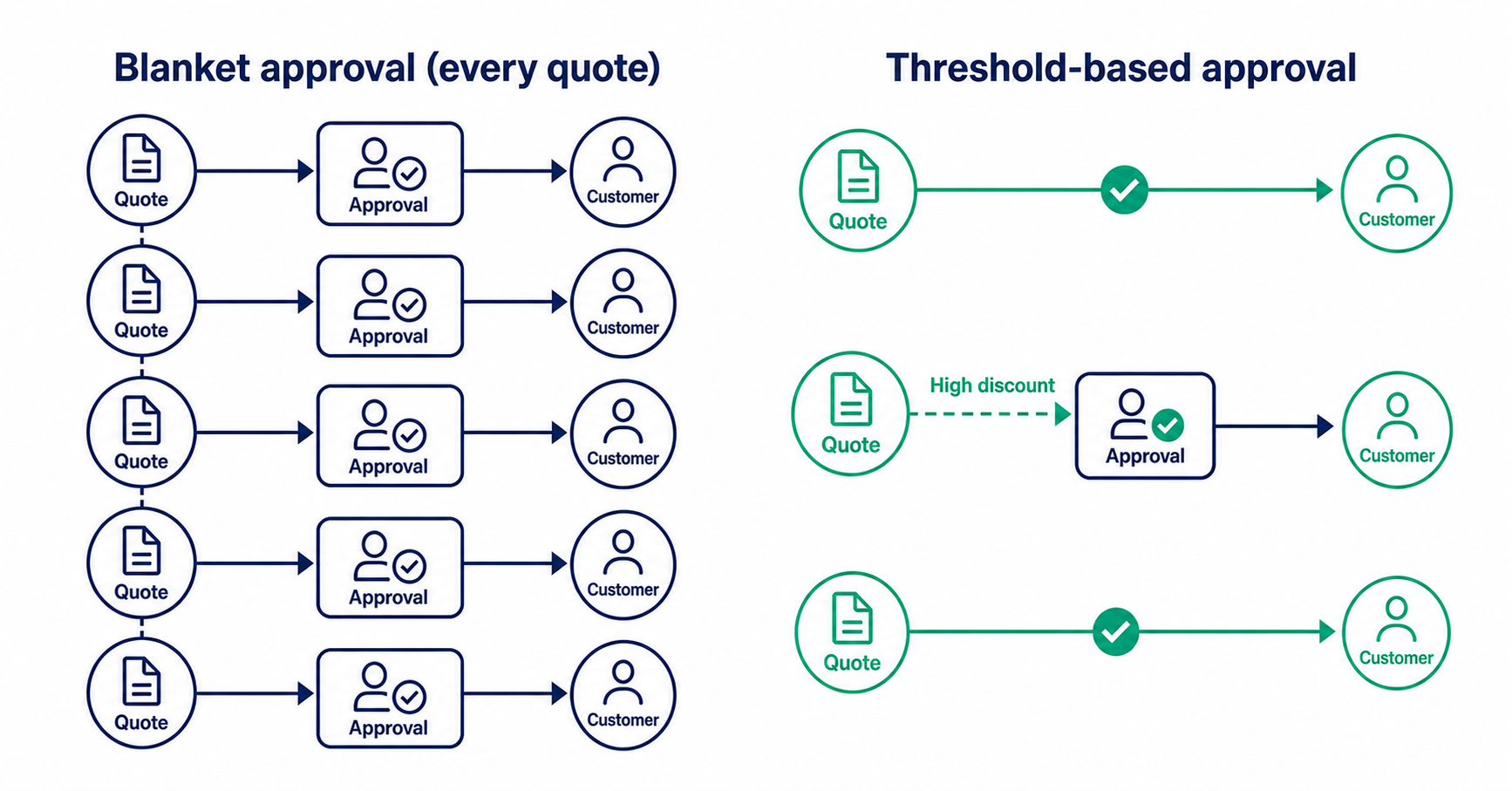
Threshold-based triggers, not blanket requirements. The most important choice is when approval activates. Blanket approval means every quote goes through the same gate. Threshold-based approval means the gate appears only when a specific condition is met: a discount exceeding 10%, a deal over $50,000, a payment term longer than net-30. Quotes that don't cross those thresholds move straight to the customer with no delay.

For a rep quoting standard products at list price, threshold-based approval is invisible. For a rep negotiating a volume deal with a 15% discount, the gate appears and they know why. That distinction matters because it puts oversight where it's actually needed and removes the overhead from the 80% of quotes that don't require it. A rep who needs manager sign-off on a 5% discount is a rep waiting on a response for a deal that could have closed today.

Parallel routing when multiple approvers are required. Some deals legitimately need more than one sign-off. A discount above 12% might require both the sales manager (for the pricing decision) and finance (for the payment terms). The question is whether those two reviews happen at the same time or one after the other.

Sequential routing means finance can't even see the quote until the sales manager approves it first. If the sales manager takes a day, finance doesn't start their review until day two. For a deal waiting on two sign-offs, that can add 48 hours. Parallel routing sends the request to both approvers at the same time. Both reviews can complete the same day, and the deal moves on the faster of the two responses, not the slower.

Time limits with automatic escalation. An approval request with no deadline sits in an inbox until someone acts on it. A rep following up manually adds overhead to their day and puts them in the uncomfortable position of chasing their own manager. A 24-hour escalation rule changes that entirely.

If the approver doesn't respond within 24 hours, the request automatically routes to their backup or escalates to the next level. The rep doesn't have to follow up. The system handles it. Aptarro ran this setup and cut negotiation time by 79%, in part because approvals that previously stretched across multiple days resolved within a single business day. The escalation rule was the forcing function.

What a working approval workflow looks like for a 50-person manufacturer

A manufacturer in the 50-employee range typically has two or three people with pricing authority and a sales team of five to ten reps. A working approval workflow for that team looks something like this.

The rep builds the quote in the CPQ tool. If the discount is under 10% and the deal is under $40,000, the quote routes directly to the customer. No delay, no queue.

If the discount exceeds 10%, the request goes to the sales manager with a summary of the deal, the proposed pricing, and the margin impact. The manager has 24 hours to approve, return it for revision, or decline. If they don't respond, the request escalates to the VP of Sales automatically.

If the payment terms extend beyond net-30, that flag routes to finance in parallel with the manager review. Finance reviews the terms while the manager reviews the price. Both approvals can clear the same day.

The rep sees approval status in real time inside the same tool they used to build the quote. When it's approved, the quote is ready to send. When it's returned, they get the reason without a phone call or a separate email thread.

This setup doesn't remove oversight. It focuses oversight on the decisions that actually require it. Standard deals move without delay. Exceptional deals get the review they need. The approval workflow earns its place without becoming the reason a ready-to-close deal waits three days.

For more on how approvals factor into deal management broadly, see The Hidden Deal Killer: Quote Approvals That Live in Email.

Latest Articles

Introducing Guided Selling

Introducing Guided Selling

Discover how Guided Selling transforms your quoting process in HubSpot, ensuring consistent and accurate quotes through structured discover...

How HubSpot Partners Are Building Recurring Retainer Revenue

How HubSpot Partners Are Building Recurring Retainer Revenue

A hubspot partner cpq service line doesn't require building a new practice from scratch. It requires a productized offer, a discovery playb...

Your Price Book Is Only as Good as the Last Time Someone Updated It

Your Price Book Is Only as Good as the Last Time Someone Updated It

A price book is only as good as the last time someone updated it. Here is how manufacturers keep theirs from becoming the source of the quo...