Product Releases: September Wrap Up
 Ryan Huff: Oct 2, 2026, 12:00:00 AM
Here's what shipped and which plans each one is on. Ramp Pricing and Deal fields are the only Enterprise plan item, and the rest reach every plan.

Here's what happens when reps build quotes from scratch. A rep opens a blank quote. They start remembering what goes into the bundle — the main product, the accessories, the service component, the upgrade options. They maybe check a spreadsheet. They maybe ask someone. They type in the prices they remember. Sometimes the bundle has a 12 percent discount if you take the full package. Sometimes there's a floor price on the service line. Sometimes the accessories are actually cheaper if you configure them a different way.
The rep doesn't remember all of that.
Neither does anyone else, which is why it only works if one particular person is here. The quote goes out. Deal closes. Then someone in operations opens it and realizes the bundle doesn't match what the customer expected, or the margin was lower than policy allows, or two of the service components shouldn't have been included together.
Right now, quoting is a free-for-all. The rep is the system. If they know it, it works. If they don't, it gets guessed. Your margins are exposed to the entire sales team, every quote.
Here's why bundles and guided selling stop that cycle, and what the teams who've closed it actually did.
When a rep builds a quote without guardrails, three things go wrong:
The "one guy in the company that controls all the bolts" isn't a system, it's a mess waiting to happen.
A bundle isn't just a package discount. It's a rule. It says: these products always go together. This discount applies to this product combination. This accessory can only be added if the main product is selected. This service tier requires approval when the total goes above a threshold.
Guided selling is the workflow that makes the bundle actually work. Instead of a blank quote, a rep starts with a guide. Pick the main product. The system shows them which accessories are compatible. Pick a tier. The system shows them the included services and optional add-ons. The system calculates the bundle discount automatically. The system shows the margin on each line. If the rep tries to quote something outside policy, the quote flags it for approval instead of letting it slip through.
That's not bureaucracy. That's a structure that doesn't exist without someone remembering it.
Here's what it looks like in a real workflow:
A rep at a commercial furniture company needs to quote a multi-room setup. They open HubSpot, start building a quote, and the guided quote builder walks them through it.
Room one: choose the base furniture piece. The system shows compatible configurations. Choose a finish. The system shows which care packages are typically bundled with this finish — a three-tier option appears. The rep picks the mid-tier. The system includes the training and support that comes with it.
Room two: the rep selects the same base piece but a different finish. The system shows that this finish qualifies for a volume discount since the customer is buying two rooms.
The system applies the bundle discount automatically. The rep never has to calculate it. The rep never has to remember which finishes qualify for the volume discount. The quote is right the first time because the logic is in the system, not in the rep's head.
That same process would take a different rep three times longer to build manually. And they would probably miss the volume discount.
Speed matters, but it's the side effect. The real gain is margin discipline that doesn't depend on rep memory.
When a rep builds a quote inside a guided workflow powered by bundle logic, they can't make certain kinds of mistakes. They can't apply a discount outside policy because the policy is in the rule, not in their judgment. They can't miss a required service component because the bundle says it's required. They can't quote an incompatible configuration because the system blocks it. The quote is accurate before it leaves HubSpot.
Accuracy drives speed. When the quote is right the first time, the customer doesn't need a revision. The deal doesn't sit in a follow-up loop. Approvals that would normally happen because the quote violates policy don't happen — because the quote meets policy by default. The deal moves at the speed of the quote, and the quote moves faster because no one has to rework it.
And none of that requires you to retrain your sales team. You're not making quoting more complicated. You're making it less dependent on memory. A new rep starts, follows the guide, and their first quote has the same bundle logic, the same discount policy, and the same margin discipline as a rep who's been here for five years.
Teams that only have a discount policy document report that reps still go rogue. They exceed the threshold. They apply a discount they shouldn't. They say the customer is special.
Teams that have built guided selling with bundle logic into their quote builder report something different. Reps still want to make the deal. But the system shows them the margin impact before they make the exception request. They see what the discount costs. They see what the customer is asking for. And then they either accept the margin or they escalate the request with eyes open. The reps aren't more compliant because they're better people. They're more compliant because the rule is in the workflow, not in a policy doc they read once.
That's why margin discipline doesn't require training overhead. The discipline comes from the system, not from a three-hour quoting-best-practices workshop that half the team skips.
You might assume bundles and guided selling matter only in complex manufacturing. In reality, these structures apply wherever customers buy more than one thing at once and the bundle pricing differs from selling the pieces separately.
A crematory company selling equipment and refractory service together has different pricing than selling the equipment alone. A park model dealer selling an RV and upgrades and financing terms has different margin on the bundle than on each piece. A lease company quoting equipment and maintenance and support upgrades has different approvals depending on the bundle configuration. These aren't exotic cases. These are the standard cases — and in every one of them, the margin changes based on what's bundled together.
If that logic lives in a rep's memory, it leaks. If it lives in a system, it doesn't.
Not the bundles in the product catalog. The bundles that actually close deals. Drill with chuck and two accessories. Furniture with care package and training. Equipment with service and refractory. Equipment with upgrades and delivery and installation. Write down what goes with what, and what the discount is when they're bundled together.
What accessory is required for what base product. Which products can't be quoted together. What customer type gets what service tier included. What discount applies to what configuration. Get it out of their head.
It should walk a rep through the bundle step by step, apply the discounts automatically, and show the margin in real time. The rep follows the guide. The bundle is right. The margin is protected. The deal closes faster because nobody has to loop back and fix it.
Teams across industrial equipment, healthcare, commercial grounds-keeping, and security hardware have closed the gap between free-form quoting and guided selling powered by bundle logic.
What they have in common is a quoting layer inside HubSpot that walks the rep through the bundle, enforces the rules automatically, and calculates the discount without asking the rep to remember.
That's the work Quotivity does. If you're stuck with reps building quotes from scratch and want to keep them from going rogue, get a demo and see how Quotivity can help.

Ryan Huff: Oct 2, 2026, 12:00:00 AM
Here's what shipped and which plans each one is on. Ramp Pricing and Deal fields are the only Enterprise plan item, and the rest reach every plan.
 Ryan Huff: Sep 30, 2026, 9:50:30 AM
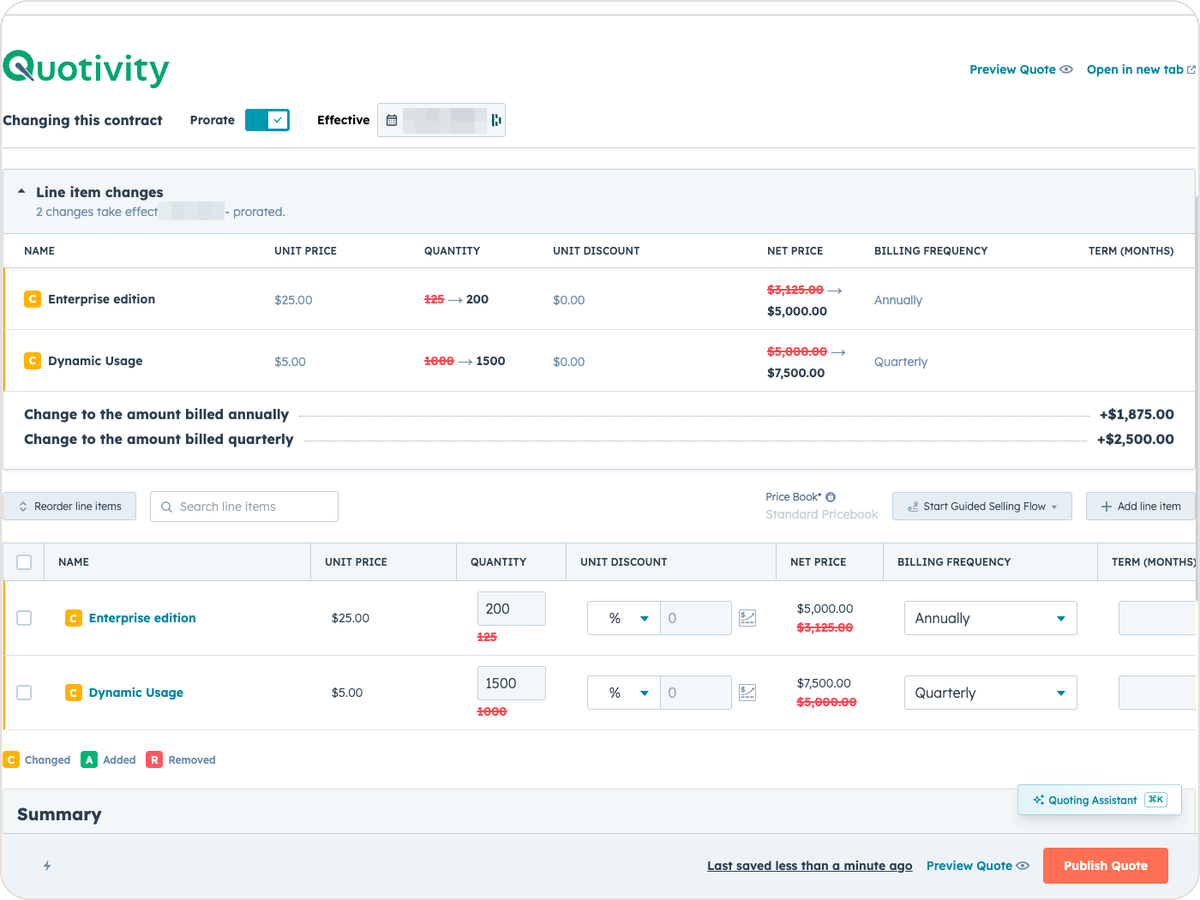
An equipment maker sells a bottler one packaging line. Partway through the term, the bottler calls back. Two more lines are going in, and they want...
Ryan Huff: Sep 2, 2026, 12:00:00 AM
Three changes from August for whoever maintains your Quotivity setup. Two of them, BLANKVALUE and bundle member summaries, are on the Enterprise plan.
 Quotivity : Jul 23, 2026, 3:15:00 AM
Most profit leakage isn't a pricing problem. It's a quoting process problem. Here are eight questions that surface where yours is hiding.
 Quotivity : May 26, 2026, 12:46:30 PM
The bottleneck in most quote cycles isn't the rep. It's the handoffs, the lookups, and the approvals that were never designed to be fast. Here's how...
 Quotivity : Mar 17, 2026, 7:45:00 AM
If quotes take too long to build, pricing lives in spreadsheets, or discount approvals slow deals, your team may have outgrown its quoting process....